
 Add to Preferred Sources
  Add
Add

Registered Agent and Registered Office Requirements: A Complete Guide
For most beneficial owners, a registered agent’s work is largely invisible...

Both the Cayman Islands and the Bahamas are two of the most popular offshore jurisdictions among business owners, investors and corporate groups. Making the right choice between these jurisdictions can be nuanced while having long-lasting consequences on your compliance burden, banking access, and long-term scalability.
It takes a clear understanding of the differences in legislation, business environment and substance requirements to choose the most suitable option for your requirements. Here is the breakdown of Cayman vs Bahamas company formation to inform your decision-making process and prepare for the consultation with professional advisors.
In the Cayman Islands, the most commonly used type of offshore company is the Exempted Company, which is a legal entity that does not carry on business within the jurisdiction. Designed specifically as an offshore entity, a Cayman Islands Exempted Company (CIEC) can have at least one director or shareholder who need not be a resident.
For investors looking for an alternative, the Bahamian International Business Company (IBC) presents another strong option. Providing for ease of administration at an economical price, the IBC is known as a popular offshore vehicle globally. Similar to the Cayman Exempted Company, an IBC has no direct tax requirements and provides for the confidentiality of beneficial owners.
Both the Cayman Islands and the Bahamas are zero-tax jurisdictions for personal income and corporate tax, capital gains tax, and inheritance tax. While taxes in your domestic jurisdiction may still apply, the tax neutrality in the Cayman Islands and the Bahamas allows structuring your operations without the risks of double taxation.
An offshore company registration in both jurisdictions requires having at least one director and one shareholder who need not be residents, as well as a local registered agent. For Cayman Islands company formation, you can usually register an Exempt Company within three to five days. For the comparison, an International Business Company formation in the Bahamas can be done in as little as 24 to 48 hours.
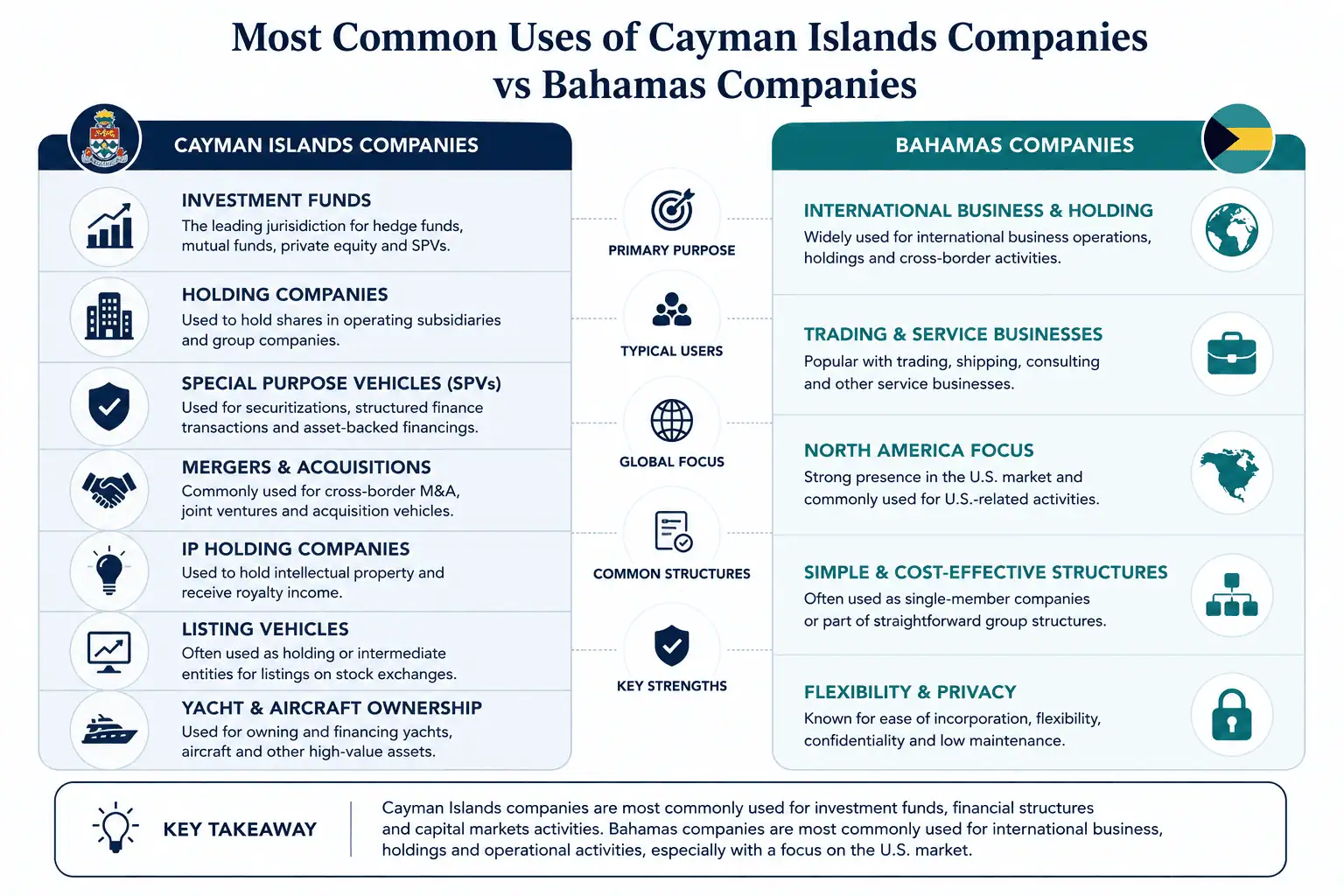
Generally, the Cayman Islands offers a range of sophisticated offshore vehicles, popular among institutional investors and funds, which include the Exempted Company, LLC, Segregated Portfolio Company (SPC), and Foundation.
In the Bahamas, the list of offshore legal entities includes the International Business Company, Exempt Limited Company, Segregated Accounts Company, and Foundation, which are preferred by private investors, fintech companies, and holding structures.
The Cayman Islands is known for its more complex regulatory environment, commanding higher registration and maintenance fees. At the same time, opening and registering an IBC in the Bahamas usually comes at lower initial and annual costs.
When you compare Cayman vs the Bahamas for privacy concerns, in both cases, the information about ultimate beneficial owners (UBOs) of offshore companies registered within these jurisdictions is generally not accessible to the public.
However, under the UBO disclosure regime in the Cayman Islands, the data on beneficial owners can be accessible to individuals or business entities who can demonstrate a legitimate interest. These include journalists, public organisations, financial crime investigators, or persons involved in actual or potential business relationships. At the same time, the UBO information related to companies registered in the Bahamas can be disclosed only to authorities, including law enforcement and the Financial Intelligence Unit, upon official request.
Both the Cayman Islands and the Bahamas are part of the Commonwealth operating under British common law, which generally supports strong investor protection.
Offshore companies operating in the Cayman Islands are overseen by the Cayman Islands Monetary Authority (CIMA) recognised in major jurisdictions for its high compliance standards. In the Bahamas, the compliance oversight is provided by the Securities Commission of the Bahamas and the Bahamas Financial Services Board, which actively introduce new legislation to align it with international standards. Both jurisdictions enforce AML and KYC requirements for all offshore company registrations.
Both the Cayman Islands and the Bahamas are tax-neutral jurisdictions, which makes them a strong choice for setting up an offshore structure. Except for the VAT applied for certain domestic operations in the Bahamas, both jurisdictions have a zero rate across all major taxes as summarised in the table below:
| Tax Category | Cayman Islands | Bahamas |
| Capital Gains Tax | 0% | 0% |
| Corporate Tax | 0% | 0% |
| Inheritance Tax | 0% | 0% |
| Personal Income Tax | 0% | 0% |
| VAT | 0% | 10% (applied to certain local operations) |
| Wealth Tax | 0% | 0% |
| Withholding Tax | 0% | 0% |

As one of the major offshore jurisdictions for institutional investors in the Caribbean, the Cayman Islands has an established network of around 100 international and local banks. While passing the KYC/AML procedures and submitting extensive documentation are usually required, some banks allow opening an account for non-residents without visiting the jurisdiction.
Similarly, major banks in the Bahamas offer the option to apply for opening a bank account online, although not every bank offers this service, and some would require extensive documentation. Represented by major international banks and local banks, the Bahamian banking sector leads in digital banking, operating the world’s first digital currency, supported by strong digital asset and fintech policies.
For many business owners, the cost factor for setting up and maintaining a legal entity is one of the major differences when comparing the Bahamas vs the Cayman offshore company.
Generally, opening an offshore entity in the Cayman Islands takes a few days and is associated with higher initial fees and maintenance costs due to the higher level of regulatory complexity and global appeal to institutional investors. Meanwhile, registering a legal-entity in the Bahamas is often possible within 24-48 hours and requires lower initial and annual costs, as summarised in the table below.
| Costs Factor | Cayman Islands | Bahamas |
| Set up time | 3-5 days or longer | 24-48 hours |
| Costs of registering a company (not including government fees) | $2,800-$5,000 | $1,800-$3,000 |
| Annual Maintenance Fees | $3,200-$6,000 | $1,800-$2,000 |
The Cayman Islands and the Bahamas are internationally recognised offshore jurisdictions with strong regulatory credibility both in the EU and the US. The Cayman Islands has implemented a series of legislative reforms to align its regulations with global compliance requirements. Its recent CRS amendments, effective January 01, 2026, and adoption of Crypto-Asset Reporting Framework (CARF) harmonise the legislation of the Cayman Islands with global standards and make this jurisdiction even more attractive for corporate groups seeking a future-proof offshore structure.
Similarly, the Bahamas participates in the OECD’s Common Reporting Standard (CRS) and the Foreign Account Tax Compliance Act (FATCA), aligning its regulations with the global framework. Positioned as a hub for new financial technologies, the jurisdiction has implemented the Digital Assets and Registered Exchanges (DARE) Act, attracting companies from the fintech and blockchain spaces.
In the Cayman Islands, offshore companies engaged in fund management, IP holding, financing, or banking must demonstrate physical presence and conduct operations within the jurisdiction. Pure holding companies in the Cayman Islands can have reduced economic substance without running local operations. While the Bahamas has similar requirements, opening an International Business Company in the jurisdiction generally does not require maintaining a physical office or operations, provided other regulatory requirements are met.
In both the Cayman Islands and the Bahamas, an offshore company needs to have a registered agent and appoint local directors. The registered agent conducts the initial registration, provides a physical address and ensures the exchange of official correspondence with the authorities, while local directors ensure official representation.
When business owners, investors and corporate groups compare the Cayman Islands vs the Bahamas for opening an offshore entity, the main factors to consider include the purpose of opening an offshore structure, the type of preferred business entity, and costs.
While both jurisdictions have a zero tax rate on personal or corporate income and offer ease of registration, they differ in access to UBO records, the type of available entities, the regulatory environment, and the costs of setting up and maintaining a legal entity. The Cayman Islands remains a preferred choice for institutional investors, while the Bahamas caters to private wealth, fintech companies, and holdings. For more information on Cayman vs Bahamas company formation, please don’t hesitate to contact the Astra Trust team for a personalised consultation.
Generally, opening an offshore company in the Cayman Islands is a common choice among institutional investors and corporate structures. This jurisdiction offers sophisticated regulations and legal entities and is associated with higher company set-up and maintenance costs. At the same time, the Bahamas’ offshore vehicles, such as an International Business Company, require lower costs and maintenance and are a common choice for family offices, private wealth, holdings, and fintech operations.
Both the Cayman Islands and Bahamas have zero tax rates for all major taxes, including corporate, income, capital gains, and inheritance tax. The only difference is that the Bahamas applies a 10% VAT to a limited range of local operations, which is not applied in the Cayman Islands.
Generally, standard holding companies in the Cayman Islands and the Bahamas have reduced economic substance requirements and do not have to maintain a local office, staff, or operations. At the same time, offshore entities engaged in certain activities, for example, fund management, IP holding and banking, may need to provide for local presence.
The best jurisdiction depends on your business objectives, structure type, and the investors you work with. In general, some institutional investors may prefer opening offshore companies in the Cayman Islands, while the Bahamas’ offshore entities have been a faster and more cost-efficient option for private wealth.
Generally, the information about ultimate beneficial owners (UBO) of offshore companies in the Cayman Islands and Bahamas is not accessible to the public. At the same time, the Cayman Islands can provide access to UBO information to individuals and organizations which can demonstrate a legitimate interest. In the Bahamas, access to UBO information is limited to authorities under CRS and FATCA compliance frameworks.
For most beneficial owners, a registered agent’s work is largely invisible...

The Cayman Islands is a jurisdiction with one of the most developed...

A Seychelles International Business Company (IBC) renews by paying its annual government...

Choosing between Bahamas company formation services is rarely about who can file...

Please describe your needs to receive an informative response
We will check the availability of this name in the selected jurisdiction. Provide your contacts for feedback.