 Add to Preferred Sources
 Add

Shelf and Ready-Made Offshore Companies: Why Most Jurisdictions Moved On
When a client inquires about the availability of a shelf company, that...


If you are entering a transaction, a partnership, or a dispute involving a British Virgin Islands entity, a company search is the first step in verifying who you are actually dealing with.
The way that search is conducted changed materially at the end of 2025. The BVI Financial Services Commission now operates a public search function that allows anyone to confirm a company’s existence and order a search report directly, without going through an intermediary first. For years, BVI searches were an intermediary-only process. That is no longer the case, and a good deal of guidance still online has not caught up.
Protecting your interests is one of the most important parts of starting or entering any business relationship, and a BVI company search is the standard way to verify whether a company in the British Virgin Islands is registered, in good standing, and operating under its correct legal name. It can confirm basic company details, but because BVI corporate privacy rules are strict, it does not usually reveal full ownership information.
Whether you are forming a limited partnership, investing, opening a new business company in the British Virgin Islands, protecting assets, or conducting wider due diligence, it is crucial to know exactly who you are dealing with. Investors, corporations, business owners, legal practitioners, and anyone involved in financial investigations or disputes often rely on a BVI company search to check legitimacy, reduce legal and commercial risk, and make informed decisions before moving forward.
The same principle applies when entering new business relationships—such searches provide essential background information on prospective partners operating within the British Virgin Islands. If you become involved in a legal dispute, a BVI company search can be an integral part of your evidence. It can also be vital for tracing assets and unraveling complex corporate structures during financial investigation, even in cases heard before a High Court.
The British Virgin Islands is well known for its strong focus on corporate privacy, which means that not all information is publicly available for those using BVI Business Companies as international structures.
As of 1 April 2026, the BVI’s legitimate interest access regime is now fully operational: individuals or organisations that can demonstrate a qualifying purpose — most commonly the investigation, prevention, or detection of money laundering, terrorist financing, or proliferation financing — may apply through VIRRGIN to inspect limited beneficial ownership information. Important to note, this is not a public register. Access is restricted to beneficial owners holding 25% or more ownership or control, requests carry a non-refundable filing fee, and companies are notified of requests through their Registered Agent with a right to object. For most day-to-day company searches, beneficial ownership therefore remains out of reach — the legitimate interest pathway exists for AML/CFT-driven inquiries, not general due diligence.
BVI law is designed to protect the legitimate privacy of individuals and entities using its corporate structures. So while you can verify a company’s existence, incorporation details, and good standing, uncovering who ultimately owns or controls the company is much more difficult through public records alone.
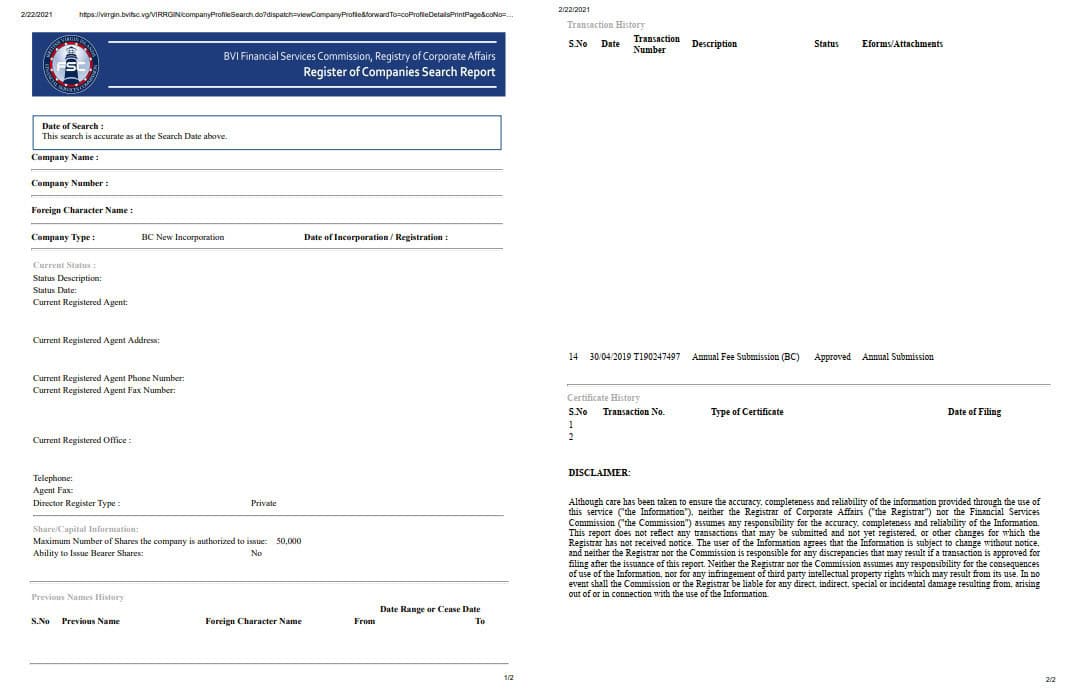
The Registry of Corporate Affairs publishes the exact contents of a search report. For a BVI Business Company or a Foreign Company, the report returns:
The transaction history is the part most people overlook. It lists every document filed with the Registry, which means that even where you cannot see the contents of a filing, you can see that it exists and when it was made. Certified or uncertified copies of any listed document can then be ordered individually.
The registered office address matters beyond formality: it is the address at which legal process is validly served on the company.
A Limited Partnership search report returns a different set of fields:
Note that share or capital information does not appear for an LP, and that the registered agent’s direct contact details do — which is occasionally more useful than the equivalent BC report.
A BVI search report will not show you shareholders. It will not show you beneficial owners. Those records sit with the company’s registered agent and, for beneficial ownership, in a central filing accessible only to competent authorities and to applicants who satisfy the legitimate interest test. Verifying legal existence and verifying ownership are two different exercises in the BVI, and only the first is available on demand.
Below is an example of the company search certificate on 2 pages.
There are a couple of primary methods to obtain information about British Virgin Islands financial entities. These methods help in gathering corporate intelligence necessary for various decisions.
The Registry of Corporate Affairs is the official source of information on a BVI company and is administered by the BVI Financial Services Commission. The Registry runs on VIRRGIN — the Virtual Integrated Registry and Regulatory General Information Network — which holds incorporation and standing data for BVI entities. VIRRGIN is the back-end system rather than a public website; public enquiries reach it through the Commission’s public search function.
Public access no longer depends on an intermediary. The Commission operates a public search function through which anyone can confirm a company’s name, number and previous names, and then order a full search report on payment of the official fee. At the initial stage the portal issues search reports, public registers, certificates of good standing and other entity certificates. Registered agents and BVI legal practitioners retain dedicated VIRRGIN access and remain the route for certified documents required for litigation, banking or regulatory filings, and for anything needing notarisation and apostille — but they are no longer a prerequisite for a basic search.
The portal handles verification. It does not handle judgement, and it does not produce documents that will survive scrutiny elsewhere.
Instruct a registered agent or BVI legal practitioner where you need one of the following:
Astra Trust conducts BVI company searches and obtains certified documents, lists of directors and certificates of good standing directly from the Registry.
The official Registry fee for a company search is US$50.00, payable in US funds before the search is processed. Search reports are ordinarily issued within 24 hours. Additional documents are charged separately, generally between US$50 and US$100 each depending on the document and whether certification is required.
Fees are set by Schedule 1 to the BVI Business Companies Act, 2004, as amended with effect from 1 July 2021 and January 2023, and are listed on Form R820.
A corporate service provider will charge a professional fee on top of the Registry fee. When comparing providers, ask three questions: what the Registry fee is, what the professional fee is, and what turnaround is actually being committed to. Any provider unwilling to separate the first from the second is not being straight with you.
To conduct the search, you will generally require the exact company name. A formal request may also require the search request form (Form R820). Precise spelling is critical, as minor variations can lead to no results or information on the wrong entity.
The company registration number, if known, is the most accurate identifier for a BVI company. Without at least the correct company name, conducting a meaningful BVI company search becomes very challenging. Try to confirm these details before initiating your search.
The British Virgin Islands has established itself as a significant international financial centre, known for its commitment to maintaining the confidentiality and privacy of corporate entities. And this is not about facilitating secrecy for illicit purposes, but protecting the legitimate privacy interests of individuals and businesses that incorporate there.
However, this privacy is not absolute. Information can be disclosed under specific circumstances. For instance, a BVI company might voluntarily file certain details publicly, or a BVI High Court order, perhaps connected to legal proceedings, could compel disclosure. Regulatory investigations by the BVI FSC, or in cooperation with overseas authorities under legal gateways, can also lead to disclosure, especially concerning AML/ CFT matters or sanctions.
The British Virgin Islands (BVI) takes part in international agreements like the Common Reporting Standard (CRS) and the Foreign Account Tax Compliance Act (FATCA), which are designed to help tax authorities share information about the real individuals who benefit from companies. However, it is important to note that this information is used strictly for official tax purposes and is not available to the general public through a standard BVI company search.
As of 1 January 2023, the names of directors of a BVI company are publicly accessible for active companies that have filed their Register of Directors with the Registry of Corporate Affairs, following the implementation of the BVI Business Companies (Amendment) Act, 2022.
Prior to this change, Register of Directors filings were generally not available for public inspection, and companies were not required to publicly disclose director details in accordance with Article 118B(4) of the BVI Business Companies Act. Earlier filings typically confirmed only that a Register of Directors had been filed, without identifying the individual directors. Nowadays, it is possible to obtain the list of names of directors as an extract from the FSC.
Only the full names of directors are publicly available. Other personal information, including date of birth, nationality, and residential address, is not disclosed to the public.
Astra Trust can assist with obtaining a list of directors together with the company search certificate.
Below is a sample of the list of directors extracted for the BVI company from the registrar.

The main limitation is how little information from the registry is publicly searchable. The publicly available data may not reveal the identity of the ownership or directorship of a BVI company through a simple public database query.
Identifying the ultimate beneficial owners (UBOs) is difficult to impossible through standard public searches. Struck-off companies can sometimes be used to hide or park assets, which is why status checks matter in due diligence. They also provide a basic security measure against fraud or misuse.
Cost is another important factor to keep in mind. A simple check to confirm whether a BVI company exists might be low-cost. But if you need official documents or detailed company reports, you will likely need to go through professional corporate service providers, which comes with fees. More in-depth searches, especially those involving legal support or investigative work into a company’s structure and activities, can become quite expensive.
Finally, the mere fact that a company is registered in the British Virgin Islands does not imply any wrongdoing. The BVI is a legitimate jurisdiction for registering companies for various international business purposes, including those involved in the financial services business. A BVI company search is just one instrument in your due diligence toolkit.
Sometimes, a standard BVI company search does not provide all the information you need, especially when dealing with a serious legal issue or when you have strong reasons to suspect wrongdoing. In those cases, you may need to look beyond the usual public records to uncover more detailed information.
If you have a valid legal claim, it may be possible to apply for a court order from the BVI High Court. This kind of order—often referred to as a Norwich Pharmacal Order—can require a company to disclose non-public details. You will need strong legal grounds and help from BVI-based lawyers to navigate the process, which can be time-consuming and expensive.
Another route is to hire a specialist investigative or corporate intelligence firm. These professionals use a mix of public data, proprietary databases, and, where appropriate and lawful, human intelligence to gather deeper insights. They are typically brought in for high-stakes matters—such as suspected sanctions breaches or financial crimes—where simple checks are not enough.
Your reason for seeking further information must be legitimate and lawful. General “fishing expeditions” are typically not supported. The BVI courts will require evidence of a genuine need for the information.
If your BVI company search has reached an impasse with publicly available data and you require more, consulting a BVI-qualified lawyer is often the most prudent next step. They can explain the prospects of success with any legal action, the potential costs involved, and how best to proceed. This is especially useful if matters involve the British Virgin Islands Financial Services Commission or any other authorities.
This route is generally reserved for serious situations, when a standard BVI company search does not provide the information needed to make important decisions. While it is possible to access more detailed company data, doing so usually involves significant effort, and financial resources.
Basic verification is now available directly through the Commission’s public search function; certified documents and interpretation remain the province of registered agents and BVI legal practitioners.
However, it should be noted that not all information is available to the public, thus limiting what a company search can do. Details like shareholder names, or comprehensive information on beneficial owners, are typically kept private under BVI law.
Sources & Links
*This article is for general informational purposes only and does not constitute legal, tax, or financial advice. Laws and regulations referenced here, including BVI beneficial ownership rules, may change after publication. Consult a qualified BVI legal practitioner or licensed corporate service provider before making decisions based on this information.
A BVI Company Search is a process of searching for information about a company registered in the British Virgin Islands (BVI). This search can provide you with valuable information about a company’s existence, status, and other relevant details.
A BVI company search confirms the legal existence and current status of a company incorporated in the British Virgin Islands. It typically includes the company’s registered name, company number, date of incorporation, registered agent, registered office, and whether the company is active, struck off, or dissolved. For active companies that have filed their Register of Directors, the names of directors may also be available.
No. Shareholder and beneficial ownership information is not publicly available in the British Virgin Islands. Such records are maintained by the company’s registered agent and may only be disclosed to competent authorities or authorized parties in accordance with applicable law. A standard BVI company search is therefore used to verify legal status rather than ownership structure.
Conducting a BVI Company Search can help you verify the authenticity of a company, check its status, and ensure that you’re dealing with a legitimate business partner. It’s an essential step in maintaining transparency and security in your business dealings.
Yes, the information obtained through BVI Company Search tool can be used for commercial purposes, such as due diligence, credit checks, or business research.
When a client inquires about the availability of a shelf company, that...

For most beneficial owners, a registered agent’s work is largely invisible...

The Cayman Islands is a jurisdiction with one of the most developed...

A Seychelles International Business Company (IBC) renews by paying its annual government...

Please describe your needs to receive an informative response
We will check the availability of this name in the selected jurisdiction. Provide your contacts for feedback.