 Add to Preferred Sources
  Add
Add

Registered Agent and Registered Office Requirements: A Complete Guide
For most beneficial owners, a registered agent’s work is largely invisible...


Before an offshore company is established, its owners should obtain advice on how their home country will treat it. The company formation itself takes four steps: choose the jurisdiction and entity type, appoint a licensed registered agent and pass their due diligence, reserve a name and incorporate, and keep the company compliant every year. In almost every offshore jurisdiction the formation process is handled remotely through the registered agent, making it easy to set up the company online.
Readers still assessing whether such a company is appropriate may wish to begin with our guide to offshore company basics. This guide addresses the practical process of establishing one, including the stages at which errors most commonly occur.
The rules of the owners’ country of residence determine how the company and its profits will be taxed, and whether the proposed structure will achieve its objectives. The review should therefore precede the choice of jurisdiction. Below are some of the most important points to consider:
Many countries treat a company as tax resident where it is actually managed, irrespective of its place of incorporation. In the UK, a company incorporated in the BVI whose directors take the substantive decisions in London is likely to be UK resident under the central management and control test, and taxable there on its worldwide profits. India applies a comparable place of effective management test. The location of board meetings, and the identity of those who actually take decisions, carry as much weight as the certificate of incorporation.
Controlled foreign company (CFC) rules may tax a company’s shareholders or parent on its profits even where no distribution is made. The UK, the US, Canada, Australia and South Africa all operate CFC regimes, and every EU member state is required to apply them under the Anti-Tax Avoidance Directive. The UK also applies separate rules to individuals, known as the transfer of assets abroad rules. Whether any of these rules apply depends on the level of shareholding, the nature of the income and the amount of tax paid by the company.
Ownership of a foreign company generally gives rise to reporting obligations in the owner’s home jurisdiction. US persons, for example, may be required to file IRS Form 5471 in respect of the company, and an FBAR where they hold a financial interest in, or signature authority over, foreign accounts with an aggregate value exceeding USD 10,000 at any time during the year. Certain countries also restrict the outflow of funds: South Africa’s exchange control regulations and India’s overseas investment rules both govern whether, and on what terms, residents may establish and fund a foreign company.

Once the home-country position is established, jurisdictions can be compared on distinctive features. The following considerations are usually decisive:
Holding shares, trading, owning intellectual property and managing investments are treated differently, particularly under economic substance rules (see step 4).
Banks apply their own policies on the jurisdictions they accept. A company that is unable to open an account serves little practical purpose.
Business partners, investors and payment providers may regard jurisdictions differently, and many consult the EU list of non-cooperative jurisdictions for tax purposes.
Annual government fees, registered agent fees and filing obligations vary considerably and, over a five-year period, outweigh the initial incorporation fee.
The information that must be filed, who may access it, and how those rules are evolving.
The choice of entity follows from the same considerations. An international business company (referred to as a business company in some jurisdictions) is the standard vehicle for holding and trading activities. A limited liability company (LLC) suits owners who require partnership-style flexibility in management and profit allocation. Where the objective is family wealth planning rather than commercial activity, an offshore trust or foundation is frequently more appropriate. Where asset protection is the principal objective, see our article on offshore companies and asset protection.
Our guide to the best countries for offshore companies compares the principal options, and the jurisdiction comparison tool sets out their requirements side by side. Jurisdiction-specific information is available on our company formation pages for the BVI, the Cayman Islands, Seychelles, the Marshall Islands, Nevis and Belize.
In most offshore jurisdictions, incorporation documents cannot be filed by the owners directly. A licensed registered agent files them, provides the company’s registered office and maintains its statutory records. In the BVI, for example, the registered agent must be licensed by the Financial Services Commission. Before accepting a new client, the agent is required to complete customer due diligence under local anti-money laundering legislation.
The following documents are typically required for each shareholder, director and beneficial owner:
Where a shareholder is a corporate entity, the agent will also require its corporate documents and equivalent information on the individuals who own and control it. Copies are normally certified by a lawyer, notary or accountant, and certain agents and banks also require an apostille.
Thorough due diligence at this stage is an advantage rather than an obstacle. Banks rely on the same information and raise the same questions, so a complete and consistent file considerably shortens the account-opening process.
Nominee services can keep the owner’s name off documents available to third parties, but they do not alter the identity of the beneficial owner, who remains identified to the registered agent and, through the agent, to the competent authorities. A nominee director owes duties to the company and must exercise independent judgement. A director who merely executes documents on instruction creates risk for all parties, including the risk that the company is treated as managed from the place where those instructions originate.
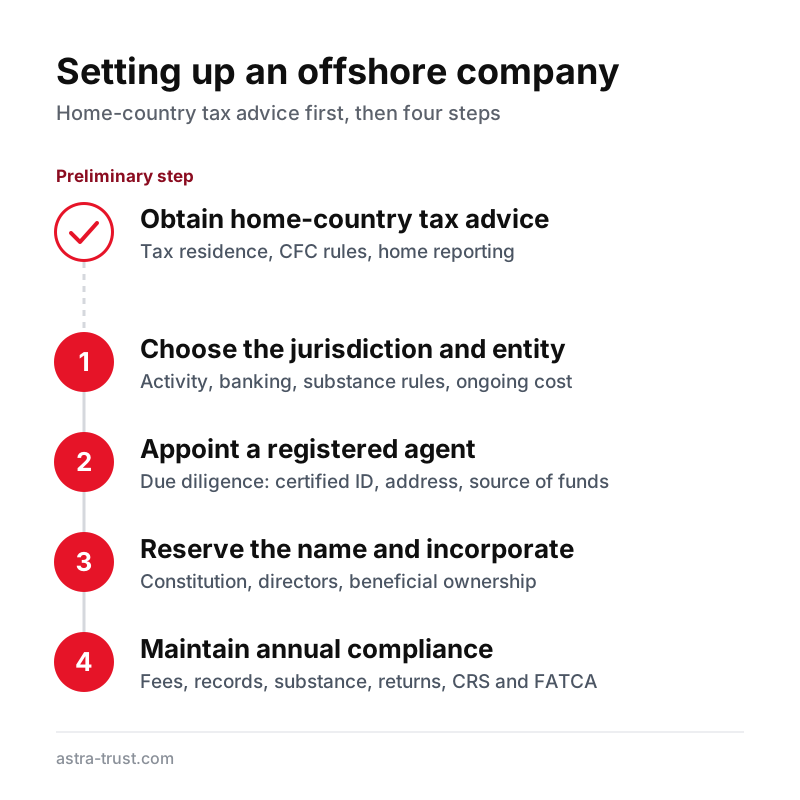
The registered agent first confirms that the proposed name is available and complies with the registry’s requirements. These typically call for a suffix such as Limited, Ltd, Corp or Inc, and restrict the use of words such as “bank”, “trust” or “insurance” without the relevant licence. Most registries permit the name to be reserved while the incorporation documents are prepared.
The agent then prepares the constitutional documents (a memorandum and articles of association, or articles of incorporation, depending on the jurisdiction), which set out the company’s share capital, share classes and internal rules. Once the registry accepts the filing, it issues a certificate of incorporation.
Immediately after incorporation:
The owners then receive a corporate document set, usually comprising the certificate of incorporation, the constitutional documents, the registers and a certificate of incumbency, certified and, where required, apostilled for use abroad.
In most offshore jurisdictions, beneficial ownership registers are not publicly accessible, although access rules continue to evolve. For a recent example, see our summary of the BVI beneficial ownership reforms.
Incorporation marks the beginning of the company’s obligations, not the end of the process. The view that an offshore company requires no filings is outdated. The precise obligations depend on the jurisdiction and the company’s activity, but typically include the following.
| Obligation | Requirement |
|---|---|
| Annual fees | Government and registered agent fees, payable each year to keep the company in good standing. |
| Registered office and agent | Must be maintained continuously. A company left without a registered agent may be struck off. |
| Accounting records | Records sufficient to show the company’s transactions and financial position, usually retained for at least five years. |
| Annual financial return | Required in certain jurisdictions. BVI companies, for example, must file a financial annual return with their registered agent within nine months of the financial year end. The return is not made public and does not require an audit. |
| Economic substance | An annual notification or report. Companies carrying on “relevant activities”, such as financing, headquarters, intellectual property or fund management, must demonstrate adequate presence in the jurisdiction. Pure equity holding companies are usually subject to a reduced test. See our guide to BVI economic substance requirements. |
| Registers and beneficial ownership | Changes of directors, shareholders or beneficial owners must be recorded and reported within the applicable local deadlines. |
| CRS and FATCA | The company is classified (for example, as a passive non-financial entity), and its banks report its accounts and controlling persons. |
| Home-country reporting | Obligations identified in the home-country advice, such as CFC calculations, information returns and disclosure of foreign interests. |
Failure to meet these obligations results in penalties and loss of good standing, and may ultimately lead to the company being struck off the register. Banks also conduct periodic client reviews and may close the accounts of companies that fall into default. Support with bookkeeping and statutory filings is available through our accounting and audit services.
A bank account does not form part of the incorporation process, but most companies require one, and account opening is typically the longest stage. The bank need not be located in the company’s jurisdiction of incorporation; many offshore companies bank in Europe, Asia or another international financial centre.
Banks generally request the corporate document set, the due diligence documents provided to the registered agent, and evidence of genuine business activity, such as a business plan, contracts or invoices, websites, and projected transaction volumes and countries. Tax self-certification forms must also be completed for the company and its controlling persons for CRS and FATCA reporting purposes, and most banks hold a video call or meeting with the beneficial owner before opening the account.
Applications are most likely to succeed when they are directed to banks that already serve the relevant type of business and region, when the information supplied is consistent with that given to the registered agent, and when any unusual features of the structure are explained at the outset. Incomplete or inconsistent information is the most common cause of delay and refusal. Further information is available on our offshore business bank account service page and in our bank comparison tool.
Once home-country advice is in place, most straightforward companies are incorporated within one to three weeks of initial contact. The certified document set typically follows within one to two weeks, and a bank account, where required, generally takes a further two to eight weeks.
| Stage | Responsibility | Typical duration |
|---|---|---|
| Home-country tax advice | Owner and tax adviser | Varies; to be completed before the registered agent is instructed |
| Choice of jurisdiction | Owner, with the registered agent | 1–3 business days |
| Due diligence review | Registered agent | 2–5 business days from receipt of a complete file |
| Name check and incorporation | Registered agent and registry | 1–5 business days |
| Certified or apostilled document set | Registered agent | 1–2 weeks, including courier |
| Bank account (where required) | Owner and bank | 2–8 weeks, longer for complex or higher-risk profiles |

Astra Trust incorporates and administers companies across the Caribbean, the Indian Ocean, the Pacific, Europe and Asia, and introduces clients to banks suited to their business. On receipt of details of the company’s intended activity and the owners’ country of residence, we recommend an appropriate structure and a realistic timetable. Contact us or see our offshore company formation service.
Disclaimer: This article is provided for general information only, reflects the position as at September 2026 and does not constitute legal, tax or financial advice. Astra Trust accepts no liability for any loss arising from reliance on it, and readers should obtain professional advice on their own circumstances before acting.
In most jurisdictions, yes. The registered agent handles the filing, and due diligence is conducted using certified documents and, increasingly, video verification. Some banks require an in-person meeting, although many accept a video call.
The company itself can usually be incorporated within one to three weeks of initial contact, often within a few business days of the registered agent approving the client file. Opening a bank account typically adds a further two to eight weeks. See the timeline above.
Yes. Residents of most countries may lawfully own a company abroad, although some countries with exchange controls require prior approval or reporting. A structure becomes unlawful through the manner of its use, for example where the company or its income is not reported in the owner’s home country, or where it is used to conceal assets or ownership. Obtaining home-country advice before incorporation and maintaining compliance (step 4) are what keep a structure legitimate.
Every offshore company must maintain a registered office in its jurisdiction, which is provided by the registered agent. Most established jurisdictions, including the BVI and the Cayman Islands, do not require a resident director for a standard company. A local director may nevertheless be needed where economic substance rules apply, and certain jurisdictions, such as Hong Kong, require a locally resident company secretary.
Yes, potential risks include regulatory changes, banking restrictions, and reputational concerns. These can be mitigated by choosing the right jurisdiction, using professional guidance, and ensuring full compliance with local and international laws.
Costs depend on the jurisdiction and the services required. They typically comprise the government incorporation fee, the registered agent’s fee and the registered office, together with any optional services such as nominee directors, bank introductions and accounting. Annual government and agent fees are payable each year thereafter. Our guide to the cheapest offshore company formation compares lower-cost options, and our offshore company formation service page sets out the services included.
For most beneficial owners, a registered agent’s work is largely invisible...

The Cayman Islands is a jurisdiction with one of the most developed...

A Seychelles International Business Company (IBC) renews by paying its annual government...

Choosing between Bahamas company formation services is rarely about who can file...

Please describe your needs to receive an informative response
We will check the availability of this name in the selected jurisdiction. Provide your contacts for feedback.