
 Add to Preferred Sources
  Add
Add

Registered Agent and Registered Office Requirements: A Complete Guide
For most beneficial owners, a registered agent’s work is largely invisible...

A private trust company (hereinafter – the “PTC”) is a legal entity that is incorporated for the single purpose of acting as trustee of a trust or a group of trusts, typically created by members of the same family. Unlike other types of trustees, it does not offer trustee services to the public nor does it compete with licensed trustees. Notably, in many jurisdictions a PTC does not require a full trust company license making it easy to establish and operate provided other requirements are met.
The absence of licensing requirements for a PTC in many offshore hubs often leads to confusion and misassumptions. Some owners consider a PTC an unregulated entity while that could be true only for some jurisdictions, only partially correct for others, and not correct at all for the rest. Below we discuss what a private trust company actually is, which offshore jurisdictions require registering a PTC structure with a regulator, why a Nevis PTC is a special case treated separately, and how to avoid settlors’ exposure when creating a PTC.
A PTC and a professional or licensed trustee have several principal differences:
The PTC holds the trust assets as trustee and provides beneficiaries with a full range of fiduciary services. When a family incorporates a PTC, it relocates legal ownership and certain decision making functions while maintaining a degree of practical control over their assets through governance and reserved powers.
Various jurisdictions apply their own set of requirements for private trust company formation.
Thus, the Cayman Islands requires a PTC to register with the local regulator and pay an annual fee. A Bahamian PTC must appoint a licensed registered representative. A British Virgin Islands PTC enjoys a statutory exemption but only while it satisfies a defined set of conditions, and forfeits the exemption the moment it does not. By contrast, a Nevis PTC is exempt from licensing requirements because the activity it carries on does not meet the statutory definition of regulated trust business.
Structuring ownership can make it or break it for a private trust company. A PTC is a company that has shareholders whose identity determines whether the PTC structure can serve its purpose.
If structured improperly, the PTC shares can be considered part of the settlor’s estate. A court may conclude that the settlor of a PTC never gave up control of the trust’s assets and exposed them to creditors’ demand. This so-called orphan problem requires careful structuring of a PTC and is addressed in the second half of this article.
One of the main reasons why families choose to create a PTC is to have a dedicated entity for handling trust’s assets and limiting their risk exposure. As it was demonstrated by court practice, a professional trustee that holds a controlling stake in a single operating business may face risks and liabilities leading to unwanted exposure. In a landmark case, Bartlett v Barclays Bank Trust Co Ltd (No 1) [1980] Ch 515, a corporate trustee holding a controlling shareholding was held liable for failing to supervise the underlying company’s board, having treated itself as a passive shareholder, and lost heavily when speculative property development went wrong.
The market response was the anti-Bartlett clause, seeking to limit the trustee’s duty to intervene in the affairs of underlying companies. The efficacy of those clauses was tested in Zhang Hong Li v DBS Bank (Hong Kong) Ltd (2019) 22 HKCFAR 392, where the Hong Kong Court of Final Appeal ultimately upheld the trustee’s protection, reversing the lower courts. That said, the litigation was expensive and protracted, highlighting the risks faced by professional trustees.
As a result, many institutional trustees may simply decline to hold a family business, a concentrated single-stock position, a yacht, an aircraft, a private equity portfolio or a digital asset holding. Where a professional trustee will accept such assets, it will often insist on indemnities, reserved powers, external valuations and delays that most owners may find intolerable. In contrast, a PTC whose board understands the asset can act at commercial speed.
Unlike an individual trustee who can resign, lose capacity, or pass away, a PTC has perpetual succession. Meanwhile, the cost of a PTC structure can be lower than the fees of professional trustees, calculated on the value of assets in their administration, depending on the size and complexity of the structure and the jurisdiction.
Forming a PTC provides a perfect opportunity to structure family governance through defining appointment of board members, forming a committee for investment and distribution decisions, and introducing the next generation.
Generally, offshore jurisdictions offering private trust company formation fall into three broad categories. These categories vary by the applicable requirements for disclosure, identity of the required local service provider as well as by consequences of poor structuring and annual costs.
Section 6 of the Banks and Trust Companies Act (2025 Revision) prohibits any person from carrying on trust business in or from within the Islands without a licence. Meanwhile, the Private Trust Companies Regulations (2020 Revision), as amended, permit a PTC to escape that requirement by registering with the Cayman Islands Monetary Authority. To qualify, the company must be incorporated under the Companies Act, conduct only “connected trust business” as defined in the Regulations, maintain its registered office with a holder of a full trust licence, include “Private Trust Company” or “PTC” in its registered name, and refrain from soliciting contributions from the public. For an unregistered PTC, at least one director must be a natural person. Registration and annual fees apply, and any change to the information filed must be notified to CIMA within 30 days.
The Banks and Trust Companies Regulation Act and the Banks and Trust Companies (Private Trust Companies) Regulations, 2007 allow forming a PTC exempt from the full licensing requirements of the Act. That said, such a Bahamian PTC will be subject to continuing Central Bank oversight through a mandatory registered representative, which is usually a Bahamian licensed bank, trust company or other approved entity that maintains the PTC’s records, holds the share register and reports to the Central Bank. The regime was consolidated and modernised by the Banks and Trust Companies (Private Trust Companies and Qualified Executive Entities) Regulations, 2025, gazetted on 5 September 2025, which brought PTCs and executive entities within a single instrument.
Section 3 of the Banks and Trust Companies Act, 1990 makes it an offence to carry on trust business from within the BVI without a licence. Meanwhile, the Financial Services (Exemptions) Regulations, 2007 (as amended, including in 2013 and 2021) offer an exception for a company which:
In the context of the exemption, the “unremunerated trust business” means trust business for which no remuneration is payable to, or received by, the PTC or any person associated with it. “Related trust business” means business in respect of a qualifying trust, or a group of related qualifying trusts, for example, where every beneficiary is the settlor, a person connected to the settlor by blood, marriage or adoption, or a charity. This exemption allows a BVI trust to be managed by the local PTC.
The BVI Business Companies (Company Names) Regulations, 2007 require the name to end with the designation “(PTC)” immediately before the corporate suffix. Additionally, the 1990 Act prohibits the use of “trust”, “trustee”, “trust company”, “trust corporation” or “fiduciary” in the name. If the conditions cease to be satisfied, the exemption can be rescinded and trust licence requirements would apply.
Article 7 of the Financial Services (Jersey) Law 1998 requires entities to implement formal registration to carry on trust company business. Meanwhile, paragraph 4 of the Schedule to the Financial Services (Trust Company Business (Exemptions)) (Jersey) Order 2000 exempts a company
The registration framework is therefore preserved indirectly: the PTC is unregistered, but the administrator behind it is fully regulated. Guernsey, another Channel Island jurisdiction, adopts a comparable approach under its fiduciary licensing legislation.
Singapore. Section 15 of the Trust Companies Act 2005 and the Trust Companies (Exemption) Regulations exempt a PTC from the requirement to hold a trust business licence, provided it delivers trust services solely to “connected persons” as defined and does not solicit from the public. At the same time, Regulation 4(2) requires the PTC to engage a licensed trust company to carry out trust administration services for the purpose of the anti-money laundering and counter-financing of terrorism checks mandated by the Monetary Authority of Singapore.
Currently, among main jurisdictions, Nevis remains the only one which does not apply formal registration requirements for private trust company formation. Because Nevis’s Trust and Corporate Service Providers Ordinance, 2021, defines trust business as activity carried on for profit or reward, a properly structured PTC is treated as not carrying on regulated trust business at all, so no trust licence, exemption, or PTC registration is required.
The Nevis International Exempt Trust Ordinance, Cap. 7.03 (N) (“NIETO”) defines an “international trust” as a trust registered under the Ordinance in respect of which:
(A) at least one of the trustees is either:
(B) the settlor and beneficiaries are at all times non-resident; and
(C) the trust property does not include any real property situated in St. Christopher and Nevis.
The language of the ordinance allows an unlicensed Nevis Business Corporation and Nevis LLC to become a trustee in an international trust. This makes Nevis a unique jurisdiction for private trust company formation with no licensing requirements for this purpose.
At the same time, trust and corporate services in Nevis are regulated under the Nevis Trust and Corporate Service Providers Ordinance, 2021 (Ordinance No. 2 of 2021), brought into force on 1 May 2021 by S.R.O. 4 of 2021 and administered by the Nevis Financial Services Regulatory Commission. Section 7(1) of TCSP ordinance provides that no person shall carry on any regulated activity, or hold themselves out as carrying on such activity, in or from within Nevis without a valid licence.
The critical drafting is in the definition. Section 2 defines “trust business” by reference to the activities set out in section 6 of the Ordinance carried on for profit or reward. Accordingly, the TCSP Ordinance is triggered by the commercial character of the activity, not by the bare fact of acting as trustee.
If a Private Trust Company acts as trustee for a single family, takes no remuneration from unconnected persons, does not market trustee services, and does not hold itself out as a trust services provider, then it is not carrying on trust business within the meaning of section 2. In this case, no license requirement is present for the trustee, and no exemption is needed.
Generally, the Commission issues two licence classes for Nevis businesses. A Class I licence covers formation agency, registered agent and registered office services for corporations, LLCs and foundations, and the provision of directors, shareholders, officers, managers, members and foundation board members. A Class II licence may be restricted or unrestricted; the restricted form covers registration and registered office services for trusts only, while the unrestricted form additionally permits trust business. When a PTC starts offering trustee services for profit or reward, it will need the Class II unrestricted licence.
The exposure to licensing requirements is not theoretical. A Nevis PTC may be subject to licensing requirements if it:
In real life it is not uncommon for structures to drift. A PTC formed for one family that gradually accepts trusts for business partners, in-laws outside the defined connected class, or co-investors may fall under licensing requirements, usually without anyone noticing. In these cases, an unrestricted application for Class II license, accompanied by assessment of principals, minimum paid-in capital and audited financial statements, becomes a way out although it is more challenging than getting the constitutional documents for such cases right at inception.
While a Nevis PTC can be exempt from licensing if structured correctly, it must comply with other statutory requirements including:
As a Nevis corporation or LLC, a PTC must maintain a registered agent licensed under the TCSP Ordinance. In Nevis, private trust company formation is only possible through a licensed provider using the Corporate Registry Integrated Secure System.
A Nevis private trust company must have a registered office. Under NIETO s.48(1), the registered office of the international trust is the office of the corporation, LLC, foundation or attorney acting as trustee.
Sections 43 and 44 require registration with the Registrar and annual renewal. The registration and annual fees are each EC$594 (US$220), with renewal to be applied for no later than 90 days after expiry. Failure to renew the registration may lead to striking the PTC off the register, paying penalties and having to reinstate the company.
Section 42 obliges the trustee to keep proper books of account, including underlying contracts and invoices, preserved for a minimum of five years, sufficient to determine the financial position of the trust at any time and to permit financial statements to be prepared. Knowing and wilful non-compliance with this requirement attracts a penalty of $5,000.
Except for charitable purpose trusts, section 36(4) caps the number of trustees at four. In cases involving a larger number of trustees, only the first four are considered.
Section 41 confirms that a corporate, LLC or multiform foundation trustee may act through its board of directors, board of managers or other governing body. Additionally, the PTC structure may appoint an officer, employee or agent to act on its behalf and implement board resolutions.
As a trustee of a Nevis trust, a PTC registered in the island enjoys protection provided by the NIETO, considered one of the most robust frameworks worldwide:
According to Section 61, a creditor seeking to bring any action against trust property must deposit a bond of EC$270,000 (approximately US$100,000) with the Permanent Secretary in the Ministry of Finance from a Nevis financial institution.
Sub-paragraph (v) of the NIETO section 2 definition permits a multiform foundation registered under the Multiform Foundations Ordinance, Cap. 7.08 (N) to act as a qualifying trustee in its own right. Nevis is one of very few jurisdictions in which a foundation, which is an ownerless entity with no shares and no members, can itself be the trustee, rather than merely the vehicle that owns the trustee company.
That collapses two layers into one and removes a conceptual obstacle for families whose advisers are more comfortable with civil law foundations than with common law trusts. It is also directly relevant to the orphan problem discussed next.
Since a PTC is a company, someone must hold its shares or membership interests. Structuring ownership in a PTC is critical to avoid exposure for the settlor and ensure compliance.
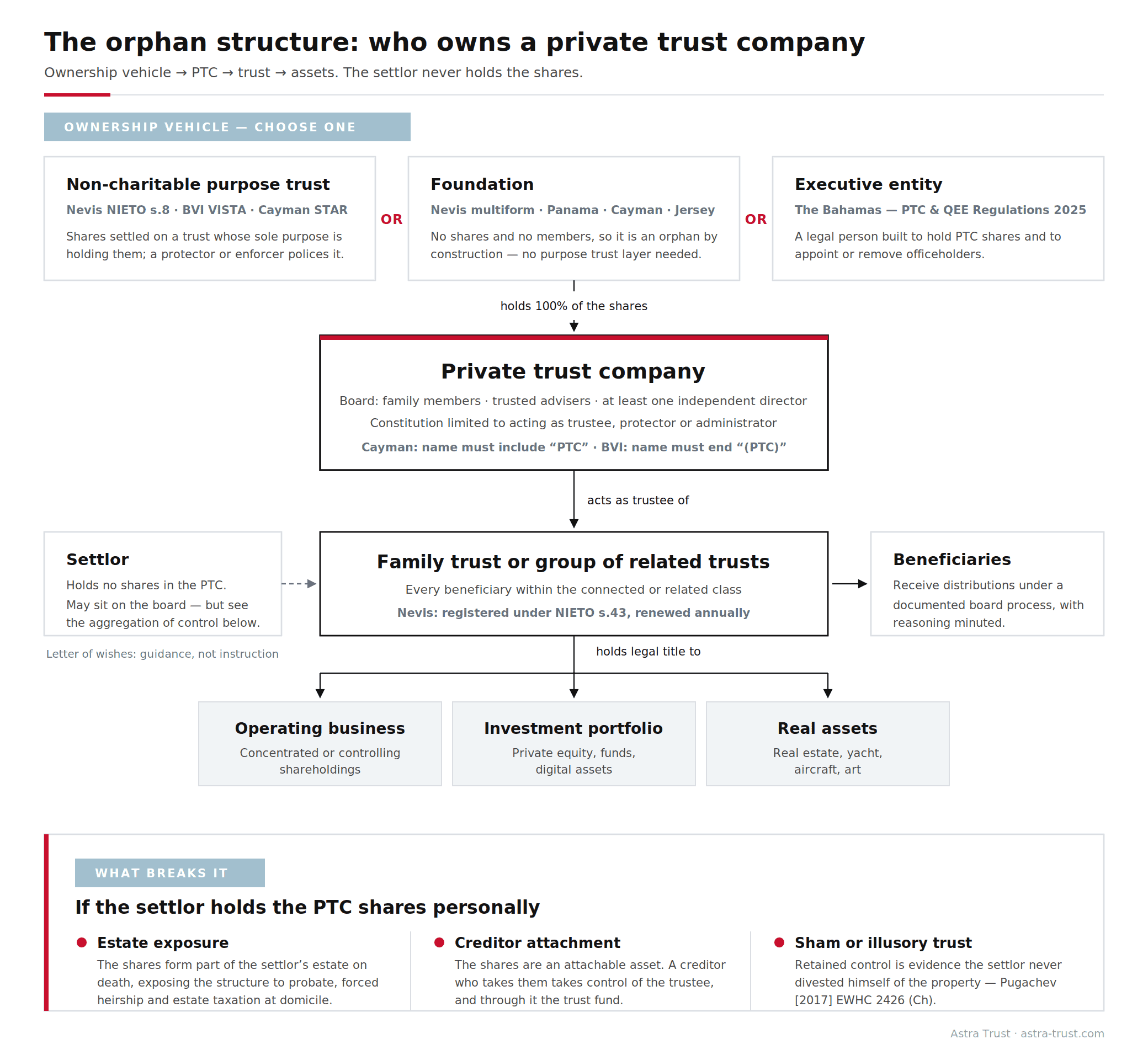
If the settlor owns the PTC shares personally, it can trigger the following consequences:
The solution to these is to make the PTC an “orphan,” owned by an entity with no beneficial owner whose interests could be attacked or inherited.
Ownership of PTC shares by a non-charitable purpose trust is a classic solution. In this arrangement, the PTC shares are settled on a trust designed to achieve a specific purpose which is holding shares in the PTC and ensuring its proper administration.
In Nevis, Section 8 of NIETO permits an international trust for a non-charitable purpose provided the purpose is specific, reasonable and capable of fulfilment, is not immoral, unlawful or contrary to public policy, and the terms provide for a protector capable of enforcing the trust together with a successor. Accordingly, Nevis vests the enforcement power in the protector rather than in a separately named enforcer.
In the British Virgin Islands, the vehicle of choice is a trust governed by the Virgin Islands Special Trusts Act (VISTA). VISTA removes the prudent-investor duty in relation to designated shares and prohibits the trustee from intervening in the affairs of the underlying company except on a permitted application by an interested party. In the Cayman Islands, the equivalent is a STAR trust under Part VIII of the Trusts Act, which requires the appointment of an enforcer distinct from the trustee.
A foundation has no shares and no members and is an “orphan” by construction, which removes the need for a purpose trust layer. Here is how various jurisdictions regulate using foundation for the purpose of private trust company formation.
There is a special Bahamas company named the Executive Entity, a legal person created to perform executive functions such as holding PTC shares, acting as protector or enforcer, or appointing and removing officeholders, making it capable of fulfilling this role without recourse to a purpose trust. The Bahamian Executive Entity is defined by the Banks and Trust Companies (Private Trust Companies and Qualified Executive Entities) Regulations, 2025 alongside the PTC regime itself.
In this arrangement, shares may be settled on a charitable trust, or held by a licensed trust company on bare trust. While both of these routes could work, they introduce a third party with legal title to the trustee, which reintroduces some of the dependency families are trying to avoid.
Bearer shares and undisclosed nominee ownership are no longer viable. Every jurisdiction discussed above now maintains a beneficial ownership register accessible to relevant authorities, and the registered agent or registered representative is obliged to identify the natural persons ultimately controlling the PTC. In today’s disclosure realities, ownership must be structured to be defensible when disclosed, not concealed.
Regulatory compliance is the easier part. When PTC structures fail on governance, they may face liabilities when exposed to litigation.
In JSC Mezhdunarodniy Promyshlenniy Bank v Pugachev [2017] EWHC 2426 (Ch), Birss J examined five New Zealand trusts under which Mr Pugachev was protector with extensive powers. After reviewing the true construction of the deeds, the court held that the powers were personal rather than fiduciary, so that the trusts did not divest him of beneficial ownership; alternatively, they were shams. The decisive factor was the totality of retained control, evidenced by how the structure actually operated.
The earlier Jersey authority, Rahman v Chase Bank (CI) Trust Co Ltd [1991] JLR 103, reached a comparable conclusion where the settlor continued to deal with the trust fund as his own.
In turn, Clayton v Clayton [2016] NZSC 29 established the related illusory trust analysis, where the breadth of reserved powers means no trust arises at all.
NIETO s.53 is deliberately expansive, and BVI (Trustee Act, s.86) and Cayman (Trusts Act, s.14) have comparable reserved-powers provisions. It is tempting to read those sections as immunising any degree of settlor control.
However, that reading is unsafe. Reserved-powers legislation protects the validity of the trust under the law of the trust’s jurisdiction. Meanwhile, it does not bind a foreign court asked to determine, under its own conflict rules and its own insolvency, matrimonial or tax legislation, whether the settlor retained beneficial ownership. Nor does it assist where the challenge is brought in the settlor’s home jurisdiction against the settlor personally.
The practical protection comes from an effective governance structure, for example:
A PTC that meets four times a year, considers the letter of wishes as guidance rather than instruction, records its reasoning and departs from the settlor’s preference at least occasionally is a very different structure. Evidentially, it stands apart from one whose minutes are prepared by an administrator.
Under the Common Reporting Standard and FATCA, applicable to US-connected structures, the trust will generally be a Financial Institution where it is managed by another Financial Institution. In turn, the PTC may be classified as an Investment Entity depending on how it is administered and remunerated. Classification drives the reporting obligation and cannot be assumed; it should be determined in writing at inception and reviewed when the structure changes.
A BVI Private Trust Company acting solely as trustee will not usually be carrying on a “relevant activity” under the BVI Economic Substance (Companies and Limited Partnerships) Act, 2018 or the Cayman International Tax Co-operation (Economic Substance) Act. The analysis is fact-sensitive, particularly where the PTC is remunerated, provides headquarters-type services to group entities, or where the underlying structure includes holding, financing or intellectual property activity. Notification obligations may apply even where no relevant activity is carried on.
A PTC incorporated in Nevis but whose board consistently meets and decides in a high-tax jurisdiction risks being treated as resident there under central management and control or place of effective management tests. Board composition and meeting location are substantive, not administrative, questions.
Controlled foreign company rules, settlor-attribution provisions and grantor trust rules in the settlor’s jurisdiction of residence operate independently of the trust’s governing law. Even Nevis’s protective legislation does not shield settlors from their application.
Nevis |
BVI |
Cayman |
Bahamas |
Jersey |
Singapore |
|
| Regulatory model | Outside perimeter | Exemption on conditions | Registration with CIMA | Registration + registered representative | Exemption on conditions | Exemption on conditions |
| Governing instrument | TCSP Ord. 2021; NIETO Cap. 7.03 (N) | BTCA 1990; Exemptions Regs 2007 | BTCA (2025 Rev.); PTC Regs (2020 Rev., am. 2024) | BTCRA; PTC & QEE Regs 2025 | FS (Jersey) Law 1998; Exemptions Order 2000 | Trust Companies Act 2005 s.15; Exemption Regs |
| Regulator filing | None | None | Registration + 30-day change notification | Via registered representative | Name notified to JFSC | None |
| Mandatory local provider | Licensed TCSP as registered agent | Class I trust licensee as registered agent | Full trust licensee as registered office | Licensed registered representative | Registered TCB administrator | Licensed trust company for AML/CFT |
| Name designation | None required | “(PTC)” mandatory | “PTC” / “Private Trust Company” | None | None | None |
| Remuneration permitted | Not for profit/reward without licence | Only within “related trust business” | Within connected trust business | Within designated trusts | Not to the public | Connected persons only |
| Entity forms | NBC, LLC, multiform foundation | BVI BC ltd by shares/guarantee | Companies Act company | Companies Act or IBC Act company | Company | Private company |
Step 1: Define the Connected Class
Align settlors and beneficiaries with the definition for connected or related persons applicable within your chosen jurisdiction, taking into account any future family members.
Step 2: Select the Jurisdiction for PTC formation
Analyze the jurisdictional treatment for assets involved, desired board location, cost tolerance, and degree of readiness for disclosure.
Step 3: Select the Ownership Vehicle
When incorporating a PTC, select an appropriate ownership vehicle, such as a purpose trust, foundation, or executive entity and ensure that the settlor never holds the shares, even briefly.
Step 4: Draft the constitutional documents
When drafting the constitutional documents, ensure they work as a genuine fence rather than a formality.
Step 5: Form the Board
Form the board, including at least one independent professional director, ensuring documented appointment and removal mechanics.
Step 6: Appoint the Local Service Provider
Select a registered agent, registered representative, or administrator depending on the jurisdictional requirements.
Step 7: Conduct Settlement
Settle the trusts. If you form a PTC in Nevis, register each trust under NIETO s.43 with a diarised annual renewal.
Step 8: Determine CRS/FATCA Classification
Document CRS/FATCA classification and economic substance position, in writing.
Step 9: Ensure Governance
Ensure meeting calendars and minute templates, a conflicts register, distribution policy, and accounting records that comply with the jurisdictions’ requirements, for example, NIETO s.42 in Nevis.
This article is provided for general information and does not constitute legal or tax advice. Statutory references are to the legislation in force at the date of publication. Fee levels and regulatory requirements change; advice should be taken on the facts of any particular structure.
Whether a private trust company is regulated or unregulated depends on the jurisdiction. For example, Cayman PTCs must register with CIMA; Bahamian PTCs operate under a licensed registered representative; while BVI, Jersey and Singapore PTCs are exempt from licensing on conditions. A properly constituted Nevis PTC is not subject to licensing altogether, because the Nevis Trust and Corporate Service Providers Ordinance, 2021, considers acting as trustee otherwise than for profit or reward as not “trust business.”
Generally yes, and it is a common arrangement. However, the risk lies not in the appointment but in the aggregation of control. Where the settlor is director, protector, investment adviser, and principal beneficiary, and the board defers to him in practice, the structure invites the analysis applied in Pugachev.
The shares are typically held by a non-charitable purpose trust, a foundation, or, in the Bahamas, an executive entity, so that the PTC is orphaned and its shares fall outside any individual’s estate.
Beyond the corporate or LLC annual fees and registered agent charges, each NIETO trust carries a registration fee and an annual renewal fee of EC$594 (US$220) under the Nevis International Exempt Trust (Fees) Regulations. There is no PTC registration or supervisory fee, which is the principal cost difference against Cayman and the Bahamas. Fee schedules should be confirmed at the time of instruction.
There is no statutory cap, but every trust must remain within the connected or related class. Accepting a trust outside that class changes the regulatory character of the PTC in every jurisdiction discussed here.
For most beneficial owners, a registered agent’s work is largely invisible...

The Cayman Islands is a jurisdiction with one of the most developed...

A Seychelles International Business Company (IBC) renews by paying its annual government...

Choosing between Bahamas company formation services is rarely about who can file...

Please describe your needs to receive an informative response
We will check the availability of this name in the selected jurisdiction. Provide your contacts for feedback.